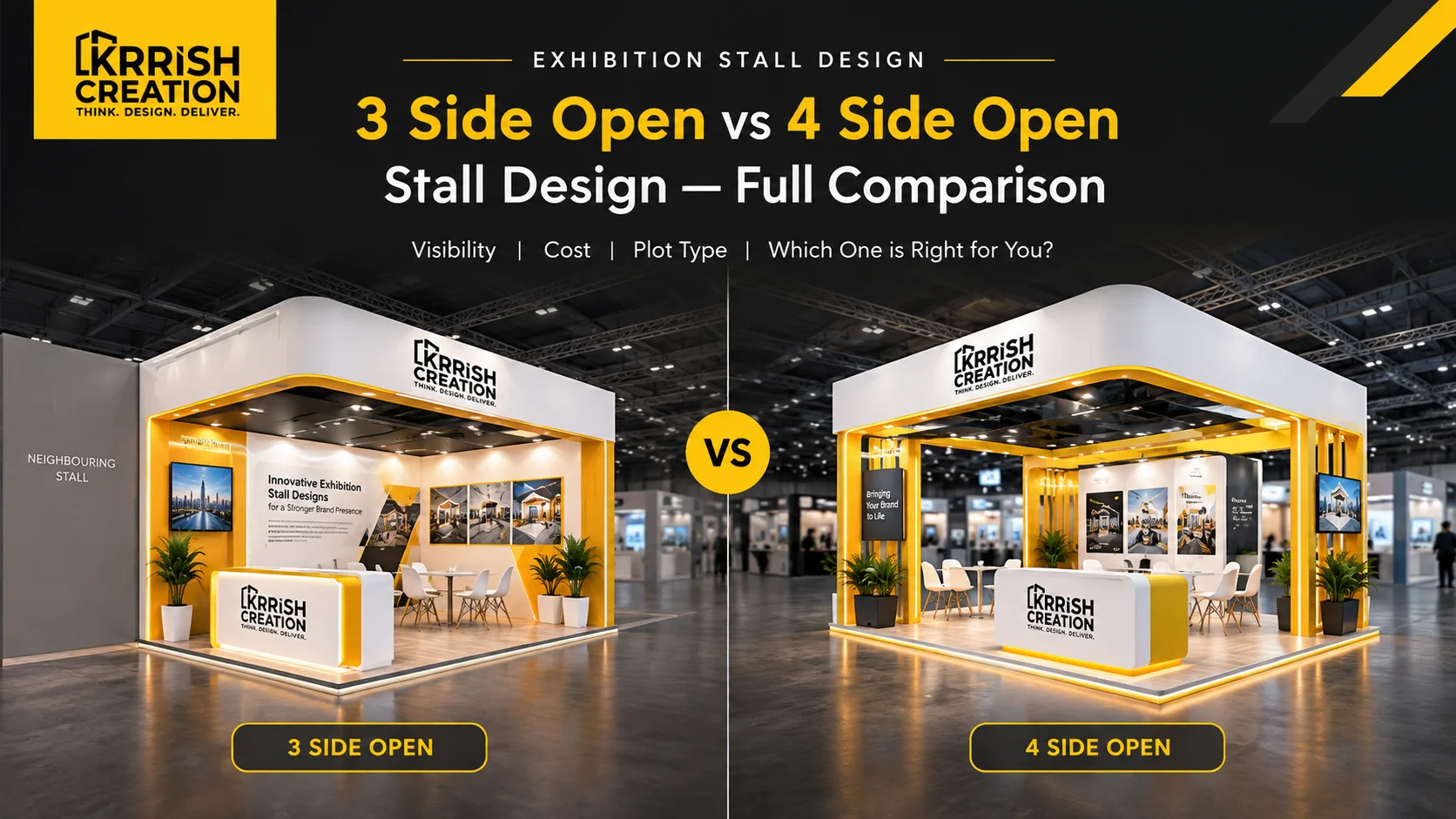
3 Side Open vs 4 Side Open Stall Design — Full Comparison
Table of Contents
3 Side Open vs 4 Side Open Stall Design: The Quick Answer
A 3 side open stall design is open on three sides and shares one back wall with a neighbouring exhibitor, typically built for peninsula or corner-adjacent plots — while a 4 side open (island) stall design is open on all four sides with no shared walls at all, built for standalone island plots. The core difference is visibility and cost: a 3 side open stall gives strong exposure at a lower structural cost, while a 4 side open island stall gives maximum 360-degree visibility but needs a bigger budget and a larger allotted plot to make sense.
The right choice depends entirely on which plot type your event organiser has allotted you — not personal preference. Below, we break down all four open-side formats, when each one actually works, and what changes in exhibition stall design and cost as you move from one open side to four.
What Does "Open Side" Mean in Stall Design?
In exhibition stall design, "open side" refers to how many sides of your booth face open aisles versus a shared or solid wall. Trade show organisers assign plots as row, corner, peninsula or island positions, and each position comes with a fixed number of open sides — this isn't a design choice you make freely, it's determined by where your stall is located on the floor plan. Your exhibition stand fabrication team then designs around whatever open-side count your plot allows.
1 Side Open Stall Design
A 1 side open stall design has a single open side facing one aisle, with the other three sides enclosed by walls (often shared with neighbouring exhibitors on two sides, and a solid back wall on the third). This is the standard "row" position and the most budget-friendly format, since it needs the least structural framing and material.
Best for: First-time exhibitors, smaller budgets, and brands that rely on a strong branded back wall rather than an open, walk-through experience.
2 Side Open (Corner) Stall Design
A 2 side open stall design sits on a corner plot, giving two open sides facing two different aisles while the remaining two sides share walls with adjacent exhibitors. This roughly doubles visitor sightlines compared to a 1 side open stall, at a moderate increase in fabrication cost.
Best for: Exhibitors who want noticeably better visibility than a row stall but aren't ready for peninsula or island-level investment.
3 Side Open (Peninsula) Stall Design
A 3 side open stall design is open on three sides and shares only one back wall with a single neighbouring stall, typically built on a peninsula plot at the end of a row block. This format dramatically increases visitor entry points and sightlines compared to a corner stall, since traffic can approach from three different directions instead of two.
It's one of the most requested formats across Indian trade fairs because it delivers most of the visual impact of an island stall without requiring the much larger plot size (and budget) an island position demands. Our exhibition stall design portfolio includes several peninsula builds where this format was chosen specifically to maximise footfall on a mid-sized budget.
Best for: Brands that want strong floor presence and multi-directional visitor flow without committing to full island-plot costs.
4 Side Open (Island) Stall Design
A 4 side open stall design — also called an island stall — is completely open on all four sides with no shared walls at all, standing independently in the middle of the floor plan. This gives 360-degree visibility and lets visitors approach from any direction, making it the highest-impact format available.
Island stalls are usually reserved for anchor exhibitors, sponsors, or brands with a significant marketing budget, since the format requires a much larger allotted plot and a fully free-standing structure (no shared walls means every wall, including branding panels, has to be self-supporting). Fabrication and material costs scale up accordingly.
Best for: Established brands, sponsors and anchor exhibitors who want maximum visibility and have the plot size and budget to match.
3 Side Open vs 4 Side Open — Side-by-Side Comparison
| Factor | 3 Side Open (Peninsula) | 4 Side Open (Island) |
|---|---|---|
| Open sides | 3 (1 shared wall) | 4 (no shared walls) |
| Visitor entry points | 3 directions | All directions (360°) |
| Typical plot type | Peninsula / end-of-row | Standalone island plot |
| Relative fabrication cost | Moderate-high | Highest |
| Structural requirement | One load-bearing shared wall | All walls self-supporting |
| Typical exhibitor type | Mid-size brands wanting strong presence | Anchor exhibitors, sponsors, large brands |
Cost Differences Explained
Cost rises with open sides for two structural reasons, not just size. First, every open side needs a self-supporting, fully finished wall or structure — a shared wall in a 1 or 2 side open stall is only finished on your side, while an island stall's walls (if you use any at all) need finishing on every visible face. Second, island stalls typically require taller or more elaborate overhead structures to remain visible and brand-forward from all four directions, which adds engineering and material cost that a peninsula or corner stall doesn't need.
How to Choose the Right Format for Your Plot
You generally don't choose your open-side format independently — the event organiser assigns your plot type (row, corner, peninsula or island) based on what you book and its cost tier, and your open-side count follows from that. The real decision point is which plot tier to book in the first place:
- • If budget is the main constraint, a 1 or 2 side open row/corner plot with a strong exhibition stall fabrication on the back wall delivers the most value per rupee spent.
- • If you want strong visibility without island-level cost, ask your organiser specifically for a peninsula (3 side open) plot.
- • If you're an anchor sponsor or have a flagship-level budget, an island (4 side open) plot maximises visibility but needs a design that works from every angle — not just one "front."
Common Mistakes When Choosing Stall Format
- • Booking an island plot without an island-appropriate design — a 4 side open stall with only one strong "front" face wastes most of what you paid for the plot.
- • Under-designing a peninsula stall's back wall — even with three open sides, the shared wall still needs strong branding since neighbouring exhibitors' visitors see it too.
- • Not confirming open-side count before design starts — plot allocations sometimes change close to the show date; confirming with the organiser before finalising your 3D design avoids a late structural rework.
Our Process for Any Open-Side Format
Whichever format your plot allows, our approach as your trade show booth contractor stays the same: we confirm your exact plot type and open-side count first, then design a free 3D concept around it, fabricate in-house, and install on-site — so the format you're paying for on the plot is fully used in the design, not designed around afterward.
Conclusion
The difference between a 3 side open and 4 side open stall design comes down to visibility versus cost: peninsula stalls deliver strong multi-directional visibility at a moderate budget, while island stalls deliver maximum exposure at the highest structural cost. Neither format is automatically "better" — the right choice depends on your plot allocation, budget and how much visual impact your event genuinely calls for. Check our upcoming exhibitions page for shows where these plot types are available, or get in touch with your plot details for a free 3D concept in the right format.